Smart factories, intelligent transportation networks, and connected energy grids are transforming how industries operate. At the heart of this transformation lies a critical challenge: how do you unify telephony, broadcasting, alarms, and monitoring into one seamless system? The answer is converged unified industrial communication—and demand is accelerating fast.

The Convergence of Telephony, Broadcasting, Alarms, and Monitoring Systems
Historically, industrial facilities operated four or more independent communication networks:
- Telephone systems (analog PBX)
- Public address and intercom (standalone amplifiers)
- Fire and gas alarm panels
- SCADA/monitoring networks
This fragmentation creates dangerous gaps. During an emergency, operators must coordinate across disconnected interfaces, wasting critical seconds. Maintenance teams manage multiple vendor relationships and spare parts inventories.
Convergence eliminates these problems. A modern integrated communication solution merges all four functions onto a unified IP infrastructure. One operator console can initiate a site-wide evacuation broadcast, trigger alarm zones, establish priority voice calls to field personnel, and pull up live camera feeds—simultaneously.
The benefits are tangible:
- Faster emergency response through automated alarm-to-broadcast workflows
- Lower total cost of ownership with shared cabling, switches, and servers
- Simplified management via centralized software platforms
- Greater scalability when expanding to new zones or facilities
Smart Factories, Transportation, and Energy: Where Convergence Delivers Results
This convergence trend is visible across three major sectors:
| Sector | Communication Need | Convergence Benefit |
| Smart Factories | Machine-to-operator alerts, PA, intercom | Unified dashboard links production alerts to voice calls |
| Smart Transportation | Tunnel emergency phones, passenger info, CCTV | Single platform manages announcements, alarms, and dispatch |
| Smart Energy | Remote substation monitoring, emergency telephony | Centralized control across unmanned facilities |
Whether it’s a highway tunnel, an offshore wind farm, or an automated warehouse, the direction is the same: one network, one management platform, full situational awareness.
Role of Industrial Telephones in Integrated Communication Architecture
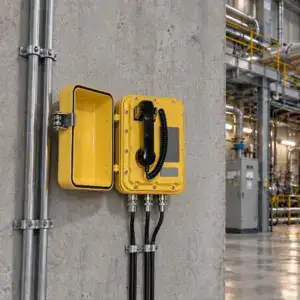
Industrial telephones are no longer standalone devices. In modern architectures, they serve as multi-function communication nodes distributed throughout a facility.
Here’s how industrial telephones fit into the integrated system:
- Emergency access points — One-touch speed dial to control rooms, with automatic location identification
- PA zone triggers — Lifting a handset or pressing a button can activate zone-specific broadcast announcements
- Alarm input/output — Built-in dry contacts connect to fire panels, gas detectors, or access control systems
- Visual indicators — Integrated LED beacons provide silent alerts in high-noise environments
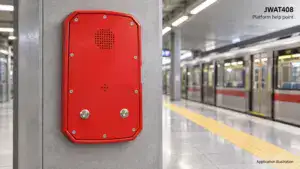
In smart transportation projects like metro systems or road tunnels, ruggedized telephones positioned at fixed intervals serve as lifeline communication points. In smart energy installations, explosion-proof telephones at unmanned substations enable remote operators to communicate with field technicians while simultaneously monitoring site conditions through the same network.
This evolution—from simple voice endpoint to intelligent network node—is what makes industrial telephones indispensable in any integrated communication solution.
Five Trends Shaping Industrial Communication Networks
1. Private 5G Complementing Fixed Infrastructure
Private 5G networks offer ultra-low latency for mobile workers and autonomous vehicles. Future architectures will blend fixed VoIP endpoints with 5G-connected portable devices for seamless coverage across smart factories and logistics hubs.
2. AI-Driven Predictive Maintenance
AI algorithms can monitor network health to predict failures, analyze voice patterns to detect distress, and automatically reroute communications during outages. This shifts communication infrastructure from passive utility to active safety tool.
3. Edge Computing for Local Resilience
Edge processing ensures faster call setup and local emergency broadcasting even when backhaul links fail—critical for tunnels, mines, and offshore platforms where connectivity interruptions are common.
4. Cybersecurity by Design
IP-based convergence inherits cyber risks. Future-proof systems embed encrypted SIP signaling, certificate-based authentication, and network segmentation as standard. Compliance with IEC 62443 is becoming a procurement baseline.
5. Modular Scalability
An integrated communication solution must scale from a 20-endpoint pilot to a 2,000-endpoint campus without redesign. Modular hardware—explosion-proof telephones, PA speakers, video intercoms, IP gateways—combined with software-defined networking enables incremental expansion as projects grow.
What This Means for Your Next Project
For engineers and procurement teams specifying systems for smart infrastructure, these converging trends carry practical implications:
- Select vendors offering end-to-end solutions—from explosion-proof endpoints to dispatch software
- Prioritize open-protocol architectures (SIP-based) for interoperability
- Choose manufacturers with deployment experience across factories, transportation, and energy sectors
- Ensure hardware certifications (ATEX, IECEx, CE) match your site classifications
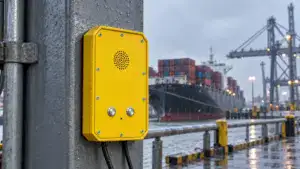
A provider that has delivered systems in refineries, metro tunnels, offshore vessels, and power plants understands the unique challenges each environment presents—from Zone 1 hazardous area compliance to vandal resistance in public spaces.
Partner with JOIWO for Reliable Industrial Communication
JOIWO is a specialized manufacturer of robust industrial communication systems for high-risk environments worldwide. With in-house R&D, certified manufacturing facilities, and proven deployments across oil & gas, mining, maritime, and nuclear industries, JOIWO delivers the harsh environment communication solutions your operations demand.
If you’re looking for a reliable industrial telephone manufacturer, contact us to discuss your project requirements or request a quote.
FAQs
What is unified industrial communication?
It’s the convergence of telephony, public address, alarm systems, intercom, and monitoring onto a single IP-based network—managed from one platform. This replaces traditional siloed systems with an integrated architecture that improves response times and reduces costs.
Why are smart infrastructure projects adopting VoIP-based systems?
Industrial VoIP provides the flexibility to carry voice, video, and data over one network while supporting centralized management, remote firmware updates, and integration with IoT sensors and building management systems.
How do industrial telephones fit into a unified system?
Modern industrial telephones function as intelligent network nodes—providing emergency voice access, triggering PA announcements, interfacing with alarm panels, and reporting environmental data, all through standard SIP/IP protocols.
What industries benefit most from integrated communication solutions?
Smart factories, transportation infrastructure (tunnels, metros, highways), oil & gas, power generation, mining, and marine/offshore installations all benefit significantly from converged communication architectures.