

Blog
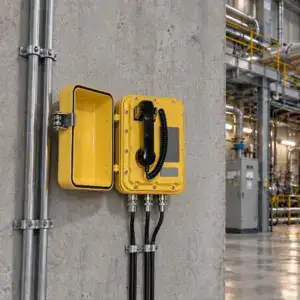
Industrial Communication Solutions for Power Plants and Electrical Substations
Power plants and electrical substations need communication systems that remain usable around turbines, generators, transformers, switchgear, outdoor yards, and maintenance zones. An industrial communication solution links field telephones, emergency call points, dispatch positions, servers, and public address equipment so operators can coordinate work and respond quickly when conditions change. Ordinary commercial telephones are designed for…
Read More
2026-09-21
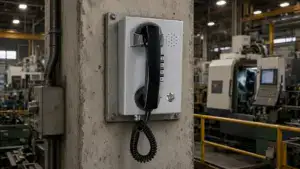
How Industrial Telephones Improve Communication in Manufacturing Plants
Industrial telephones improve communication in manufacturing plants by providing dependable voice points where office phones and mobile devices are difficult to use. A well-planned factory communication system links production operators, maintenance technicians, warehouse staff, safety teams, and control-room personnel through fixed endpoints that are easy to find and quick to answer. Each plant area creates…
Read More
2026-09-15

How Industrial Communication Systems Support Railway and Metro Operations
Industrial communication systems support railway and metro operations by giving passengers, station staff, maintenance teams, drivers, and control-room operators dependable ways to exchange information during routine service and emergencies. A complete railway communication system connects rugged telephones, passenger help points, dispatch consoles, servers, amplifiers, loudspeakers, alarms, and monitoring tools across the entire network. Each location…
Read More
2026-09-08
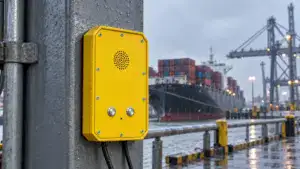
Choosing Industrial Telephones for Ports and Maritime Infrastructure
Ports need communication equipment that remains usable beside cranes, vessels, warehouses, truck lanes, and exposed service routes. A suitable industrial telephone for port operations combines clear audio with resistance to rain, salt air, dust, impact, and frequent use. This article explains how to match port communication equipment with different work areas, network architectures, and emergency…
Read More
2026-09-01

Industrial Remote Monitoring and Maintenance: The Role of Rugged Communication
The true value of remote monitoring and maintenance is the combination of data collection and emergency response. When remote monitoring systems detect a fault in offshore wind turbines or chemical pumps, executing the actual remote maintenance requires dispatching technicians to harsh, physically demanding locations. Without a rugged communication network, field teams cannot safely troubleshoot problems, consult off-site engineers, or coordinate timely maintenance. This guide…
Read More
2026-08-26

Emergency Communication Systems for Critical Industrial Infrastructure
Accidents in critical infrastructure, such as petrochemical plants, underground mines, and railway networks, can escalate in a matter of seconds. In these environments, an effective emergency response relies entirely on a robust emergency communication system. Unlike standard office setups, industrial communication networks must rely on rugged, purpose-built hardware designed to withstand explosions, extreme weather, and…
Read More
2026-08-24

Communication Systems in Industry 4.0 Transformation
Industry 4.0 communication networks let machines, sensors, and personnel exchange information in real-time. Moving beyond the legacy setups of the third industrial revolution and traditional mass production, this key technology is designed to completely transform the industrial sector. By linking floor equipment directly to ERP software and dispatch systems, plants can respond instantly to changing conditions. True smart manufacturing requires more than just automation. Modern…
Read More
2026-08-20
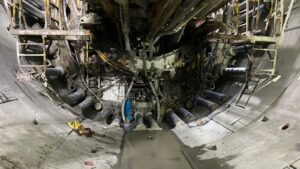
Why Industrial Communication Systems Must Support Harsh Environment Adaptation
Harsh environment communication refers to the specialized network hardware, cabling, and design practices built to keep data flowing reliably under industrial hazards. Choosing equipment explicitly rated for the actual conditions on site is the single most significant factor in ensuring long-term network stability. The sections below explore what damages industrial communication links, why off-the-shelf commercial…
Read More
2026-08-17

Mission Critical Communication for Challenging Industrial Environments
https://www.youtube.com/watch?v=iRrTZGA3u84 JOIWO industrial-grade communication systems for extreme conditions When every second and every word counts, JOIWO delivers industrial-grade communication systems engineered for extreme conditions—from explosive oil and gas zones to underground mines, tunnels, and mass transit networks. Our portfolio spans explosion-proof telephones, weatherproof intercoms, SIP-based systems, and industrial PA solutions, all built to…
Read More
2026-08-07
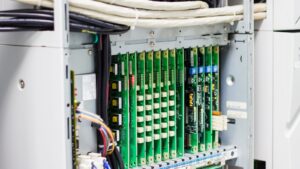
Industrial Telephone System Maintenance: Best Practices for Reliable Uptime
Industrial telecommunication systems in high-risk facilities do not fail at convenient times, and that necessitates a structured industrial telephone system maintenance program. This complex maintenance system, with the industrial telephones at its core, includes fiber optic backbones, IP PBX controllers, PA amplifiers, field speakers, and more. In this blog, we will explain how and why…
Read More
2026-07-29

Industrial Communication System Design for Large Manufacturing Plants
Large industrial plants operate as complex communication environments. A well-designed industrial communication system ties together voice, data, and safety signaling across every zone of a facility reliably under heat, dust, vibration, electromagnetic interference, and hazardous atmosphere classifications. Plant engineers and system integrators increasingly treat industrial communication as infrastructure, not an afterthought. In this blog, we will…
Read More
2026-07-24

A Selection Guide for Industrial Telephone Manufacturer
Selecting the right industrial telephone manufacturer is a complex procurement decision. The core question is whether their engineering depth, certification scope, manufacturing control, and support structure can sustain the communication system across its full operational life. This guide will serve as a criteria analysis for engineers, project buyers, and system integrators who need sharper tools for choosing manufacturers.…
Read More
2026-07-23