Les ports ont besoin d’équipements de communication qui restent utilisables à proximité des grues, des navires, des entrepôts, des voies de circulation des camions et des cheminements techniques exposés. Un téléphone industriel adapté aux opérations portuaires associe une qualité audio claire à une résistance à la pluie, à l’air salin, à la poussière, aux chocs et à un usage fréquent. Cet article explique comment adapter les équipements de communication portuaire aux différentes zones de travail, architectures réseau et procédures d’urgence.
Pourquoi les environnements portuaires ont besoin de téléphones industriels
Les communications portuaires sont affectées simultanément par plusieurs conditions. Le vent, la pluie, les embruns, la condensation et les rayons ultraviolets peuvent atteindre les équipements installés sur les colonnes des quais ou les murs des entrepôts. Les dépôts de sel peuvent accélérer la corrosion des pièces métalliques exposées et des entrées de câbles. Les grues, les moteurs, les alarmes, les chariots élévateurs, les machines des navires et les opérations de chargement créent un environnement bruyant où le son d’un téléphone de bureau ordinaire peut être difficile à comprendre.
Les équipes opérationnelles ont également besoin de points de communication faciles à repérer et utilisables avec des gants, les mains mouillées ou une visibilité réduite. Un point de communication d’urgence portuaire peut servir aux grutiers, aux agents de maintenance, aux équipes de sécurité, aux conducteurs ou au personnel à bord des navires. L’appareil doit offrir un chemin d’appel prévisible vers une salle de contrôle, un poste de répartition, un poste de sécurité ou une équipe d’intervention d’urgence.
Les téléphones commerciaux sont généralement conçus pour des locaux intérieurs propres et des températures contrôlées. Les équipements portuaires nécessitent un boîtier étanche ou protégé, des matériaux adaptés à la corrosion, une fixation robuste, des presse-étoupes appropriés et des performances audio conçues pour le bruit industriel. Les achats doivent porter sur l’ensemble de l’installation, notamment le téléphone, la ligne ou le réseau, l’alimentation, la surface de montage, le cheminement des câbles et le poste destinataire.
Adapter le téléphone à chaque zone portuaire
Quais et zones de chargement
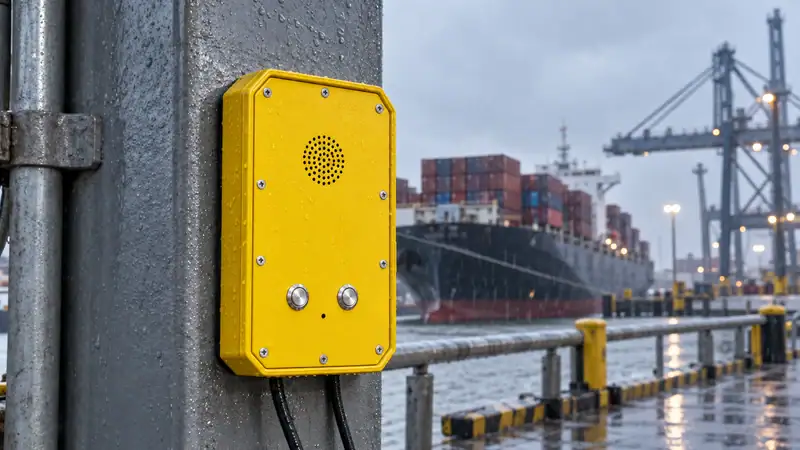
Les quais cumulent vent, pluie, embruns, machines en mouvement et longs cheminements de câbles. Le terminal de communication doit être installé à un endroit accessible aux travailleurs sans qu’ils aient à pénétrer sur une voie de circulation ou à s’approcher trop près des équipements de levage. Téléphone mural mains libres sans fil VoIP antidéflagrant Division 2 et résistant aux intempéries JWAT407 peut convenir aux endroits où l’utilisateur doit pouvoir passer un appel d’une seule pression tout en gardant les deux mains libres pour son travail. Son format de téléphone industriel à haut-parleur peut être envisagé dans les zones de chargement, aux accès aux postes d’amarrage et aux postes de commande exposés, où un combiné peut être peu pratique.
Avant de choisir un téléphone industriel pour un port, vérifiez la protection du boîtier, la résistance à la corrosion, la température de fonctionnement, le niveau sonore, les performances du microphone, l’entrée des câbles et le mode de montage. Sur un poste d’amarrage très fréquenté, le bouton d’appel et le voyant d’état doivent être faciles à repérer. La destination de l’appel doit être programmée et testée afin qu’une seule action joigne le bon poste de commande ou groupe d’intervention.
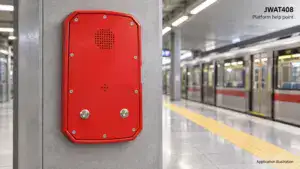
La scène de quai ci-dessous illustre un emplacement exposé où un terminal mains libres JWAT407 peut être envisagé. Vérifiez la conformité du boîtier, de l’audio, du montage et de la configuration réseau définitifs avec le cahier des charges du projet.
Entrepôts et zones de maintenance couvertes
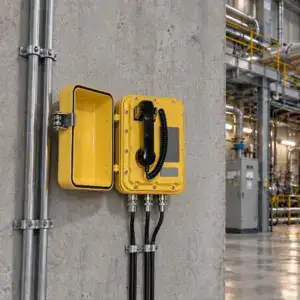
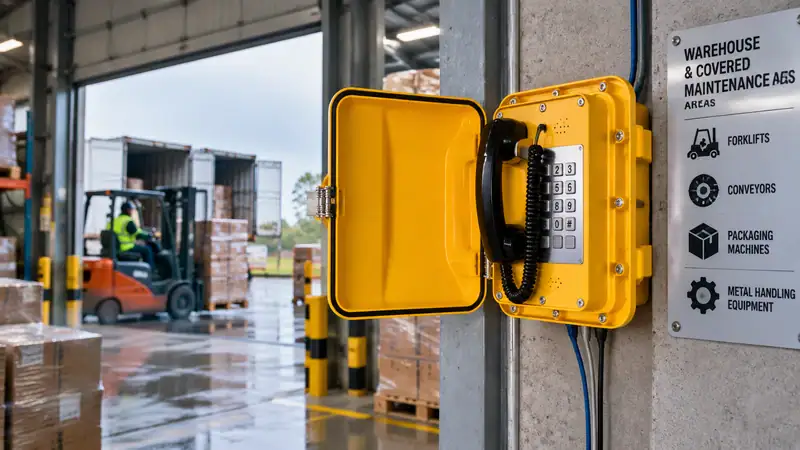
Les murs des entrepôts offrent une certaine protection contre les intempéries directes, mais les portes, les quais de chargement et les structures ouvertes sur les côtés laissent tout de même pénétrer la pluie, la poussière et l’air salin. Ces zones accueillent souvent des chariots élévateurs, des convoyeurs, des machines d’emballage et des équipements de manutention des métaux. Un téléphone avec capot tel que le JWAT301P peut protéger davantage le combiné et le clavier lorsque l’appareil se trouve près d’une porte de chargement ou d’un passage de maintenance non chauffé.
Le capot doit s’ouvrir facilement avec des gants de travail et ne pas gêner l’accès au combiné en cas d’appel urgent. Vérifiez la charnière, le loquet, le support du combiné, la protection du cordon, la disposition du clavier et le presse-étoupe. Un appareil mural nécessite également une plaque arrière solide et des fixations adaptées au béton, à l’acier ou aux panneaux isolants de l’entrepôt.
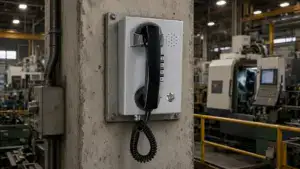
Pour un téléphone avec capot installé à l’entrée d’un entrepôt ou dans une zone de maintenance couverte, consultez le modèle Téléphone industriel résistant aux intempéries avec boîtier JWAT301P. La scène d’entrepôt ci-dessous illustre un emplacement protégé mais toujours exposé, où il convient d’examiner la conception du boîtier et de l’entrée de câble.
Parcs à conteneurs et voies de service éloignées
Dans les parcs à conteneurs, les points de communication peuvent être très éloignés les uns des autres. La visibilité, l’accessibilité et la maintenance sont essentielles, car une panne peut être découverte loin du bâtiment principal. Les appareils installés près des portes du parc, des zones de conteneurs frigorifiques, des points de ravitaillement, des voies d’inspection ou des postes de maintenance des grues doivent être clairement identifiés et répertoriés dans le plan d’intervention du site.
Pour les emplacements éloignés, les équipes projet doivent comparer les versions analogiques et SIP. Les équipements analogiques alimentés par la ligne peuvent être utiles lorsqu’un PBX et une infrastructure en cuivre sont déjà en place. Les équipements SIP permettent le routage et la surveillance centralisés lorsque le port dispose d’un réseau IP administré. Le choix final doit tenir compte de la résilience du réseau portuaire, de l’alimentation de secours, de la politique de cybersécurité et des capacités de maintenance.
Salles de contrôle et centres de répartition
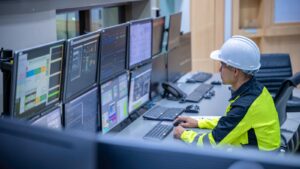
Les salles de contrôle reçoivent des appels de nombreux points sur le terrain et peuvent devoir coordonner la sécurité, les opérations maritimes, la maintenance, la manutention des cargaisons et les services d’urgence. Le poste opérateur doit permettre d’identifier facilement l’origine d’un appel, d’y répondre rapidement, de le transférer à un autre groupe et d’enregistrer l’événement lorsque la procédure opérationnelle l’exige.
Un serveur de répartition ou un PBX portuaire peut assurer la gestion centralisée des terminaux IP compatibles et des fonctions de communication associées. La plateforme doit être évaluée avec les commutateurs, la capacité des UPS, la segmentation du réseau, le routage des appels, la journalisation et les procédures de reprise. Le système de communication portuaire doit conserver une voie de secours claire lorsqu’un segment réseau ou une source d’alimentation est indisponible.
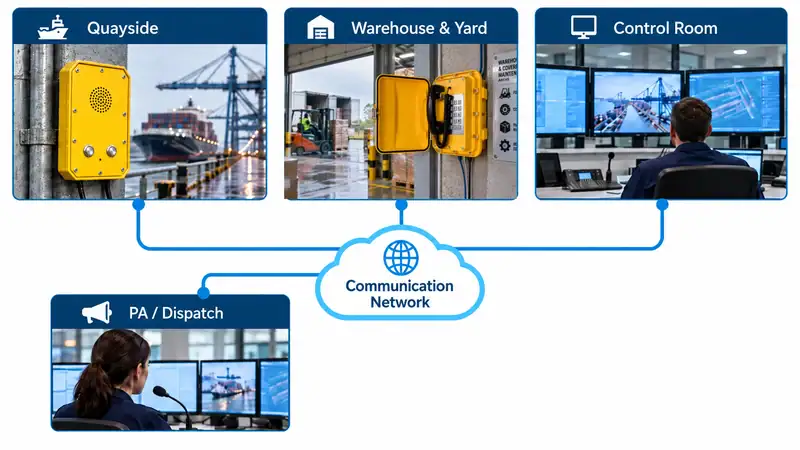
La vue système ci-dessous montre comment les modèles JWAT407 et JWAT301P peuvent relier les emplacements de terrain à une couche générique de répartition en salle de contrôle. La solution maritime plus globale constitue un bon point de départ pour examiner la coordination des terminaux, de la répartition et de la sonorisation.
Fonctionnement des communications d’urgence portuaires
Une communication d’urgence commence par une action claire sur le terrain et se termine par une intervention coordonnée. Un appel depuis un quai peut devoir être transmis au poste des opérations maritimes, tandis qu’un incident dans un entrepôt peut nécessiter l’intervention simultanée de la sécurité et de la maintenance. La conception du système doit définir les groupes d’appel, les règles de priorité, le routage des appels sans réponse, les délais d’escalade et les informations de localisation affichées à l’opérateur.
Les téléphones industriels et les interphones d’urgence assurent les communications vocales directes. Les équipements de sonorisation diffusent des consignes aux personnes présentes dans une zone définie. Ces fonctions sont coordonnées lorsque la salle de contrôle peut répondre à un appel sur le terrain, évaluer la situation et diffuser une annonce ciblée sans devoir changer manuellement de système. Les zones de sonorisation peuvent couvrir un poste d’amarrage, un entrepôt, une porte, une section du parc ou un bâtiment de maintenance.
Pour les points d’urgence extérieurs, des indicateurs visuels et un niveau sonore élevé peuvent aider les utilisateurs à vérifier que l’appel a été passé et le personnel à proximité à localiser l’appareil. Les voyants d’alarme, balises ou haut-parleurs externes doivent être spécifiés en fonction du niveau sonore du site et de la procédure d’intervention. Les équipes achats doivent demander la description d’une chaîne de signal complète, plutôt que d’évaluer le téléphone isolément.
Analogique, SIP et intégration système
Les téléphones industriels analogiques peuvent être raccordés à un PBX ou à une interface de ligne compatible et peuvent convenir aux systèmes simples point à point ou existants. Leur fonctionnement est familier aux équipes de maintenance et certaines configurations peuvent être alimentées par la ligne téléphonique. Le projet doit néanmoins vérifier le courant de boucle, la longueur du câble, la protection contre les surtensions, la mise à la terre et l’état de l’infrastructure extérieure.
Les téléphones industriels SIP et VoIP peuvent utiliser le réseau IP du port pour un routage flexible des appels, une configuration centralisée et une intégration à un IP-PBX ou à une plateforme de répartition. Ils nécessitent une alimentation adaptée, la disponibilité du réseau, une conception VLAN, la synchronisation de l’heure et des contrôles de cybersécurité. Si un port fonctionne sur plusieurs terminaux, la redondance du réseau et la capacité de fonctionnement local doivent être examinées avant de choisir le type de terminal.
| Exigence portuaire | Éléments à spécifier | Importance |
| Air salin et pluie | Boîtier étanche, finition adaptée à la corrosion, presse-étoupe, indice de protection | Limite la pénétration de l’humidité et prolonge la durée de service dans les zones exposées. |
| Bruit des grues et des machines | Microphone à réduction du bruit, combiné puissant ou audio mains libres, niveau d’alerte clair | Favorise la compréhension des consignes pendant les opérations. |
| Gants et usage en urgence | Commande d’appel large, indicateur d’état visible, combiné accessible ou fonctionnement mains libres | Réduit le temps nécessaire pour passer un appel en situation de stress. |
| Emplacements éloignés dans le parc | Compatibilité analogique ou SIP, protection contre les surtensions, alimentation de secours, point d’appel cartographié | Aide les équipes de maintenance et d’intervention à gérer les longues distances et les pannes. |
| Coordination de la salle de contrôle | Groupes d’appel, escalade, journalisation, interface de sonorisation, affichage opérateur | Relie les appels du terrain aux procédures de répartition et d’urgence. |
Liste de vérification pour l’achat d’un téléphone industriel maritime
Détails environnementaux et mécaniques
Demandez l’indice de protection exact de la configuration proposée et vérifiez s’il s’applique lorsque le capot est ouvert ou fermé. Confirmez le matériau, le revêtement, le niveau de résistance à la corrosion, l’exposition aux UV, la température de fonctionnement, la plage d’humidité, la résistance aux chocs, les fixations et l’entrée de câble. Les installations maritimes peuvent nécessiter une finition ou un mode de montage différent de ceux d’un entrepôt à l’intérieur des terres.
Audio et expérience utilisateur
Testez l’appareil à son emplacement réel. Une spécification audio de laboratoire ne remplace pas un essai sur le terrain à proximité d’une grue, d’un moteur de navire ou d’un convoyeur. Vérifiez l’intelligibilité de la parole, le niveau de sonnerie ou d’alerte, la couverture mains libres, la prise en main du combiné, la visibilité du clavier et le fonctionnement du bouton d’appel avec des gants.
Réseau et maintenance
Confirmez si le terminal est analogique, SIP ou proposé dans plusieurs configurations. Examinez l’alimentation, le PoE ou l’alimentation par ligne, la protection contre les surtensions, la distance de câblage, la capacité des commutateurs, les VLAN, l’authentification, la gestion du micrologiciel, les pièces de rechange et les procédures de remplacement. Demandez des schémas montrant la connexion du terminal au PBX, au serveur IP, à la salle de contrôle et au système de sonorisation.
Contactez-nous pour discuter de vos besoins en communication portuaire et maritime et demander un devis pour des téléphones industriels adaptés et les équipements associés.