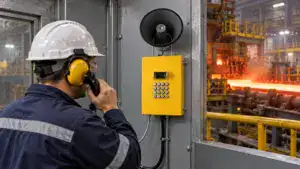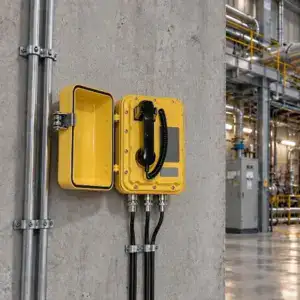
Reliable port communication depends on equipment that suits coastal exposure and call paths that reach the right operating team. Buyers should assess salt, water, wind, noise and working distances alongside dispatch procedures and maintenance access. This guide explains how to specify a marine communication system for shore-based ports, terminals and associated facilities.
Build the plan around port activities
A port contains several communication environments within one operating boundary. Berths connect marine operations with landside teams. Gatehouses handle arrivals and access. Cargo handling areas depend on coordination between equipment operators and supervisors. Workshops and utility buildings need practical links to maintenance and emergency response personnel.
Map these activities before deciding how many fixed stations to purchase. Identify who initiates each type of call, where it should be answered and what happens outside normal office hours. Fixed industrial telephones can provide known contact points alongside the site’s other communication methods. Their role should be clear in normal operations and during disruption.
Define the project boundary carefully. Shore-based port communication and onboard ship systems can have different approval and integration requirements. A product described as suitable for a marine environment still needs review against the actual installation. State whether the procurement covers terminal infrastructure, floating equipment, vessel connections or a combination of these.
Separate water protection from corrosion resistance
Coastal equipment can face wind-driven rain, airborne salt and repeated wetting and drying. Specify these exposures separately. A waterproof telephone needs an appropriate enclosure and entry arrangement for its location, while the purchasing review also needs evidence for the materials and finishes exposed to salt. A single rating cannot describe every coastal condition.
Joiwo’s Industrial Weatherproof IP SIP Phone JWAT306P combines a die-cast aluminum housing, protective door and handset for fixed SIP calling. Assess its supplied configuration against coastal exposure, network compatibility and maintenance needs.
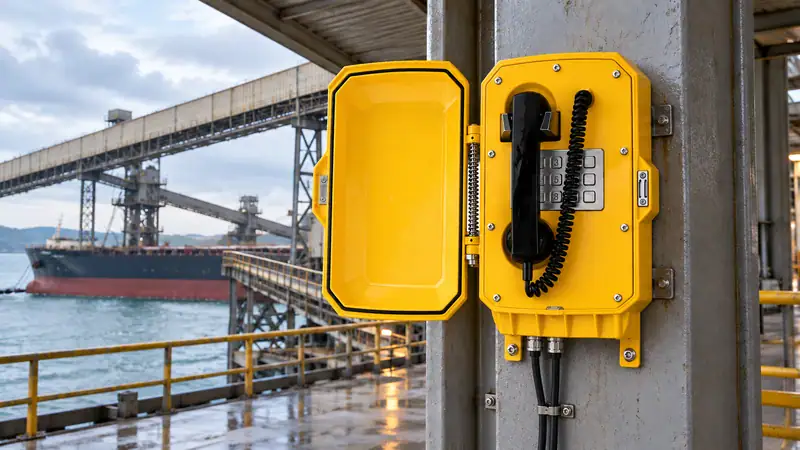
Ask suppliers to explain the relevant test method, specimen configuration and result behind environmental claims. Review exposed hinges, fasteners, handset components and cable entries as well as the main housing. Confirm whether the evidence covers the proposed finish and accessory combination. This gives procurement a more reliable comparison than a broad description such as marine grade.
Account for installation and cleaning
Place stations where normal port activity will not repeatedly damage them. Consider vehicle movement, handling equipment, mooring work and local drainage. Specify suitable cable support and compatible entry fittings. A sheltered installation may reduce some exposure, while access and safe operation remain the primary placement considerations.
Include the terminal’s cleaning practices in the specification. Water jets, detergents and accumulated salt may affect different parts of the installation. Obtain approved cleaning instructions and provide them to maintenance teams. Discuss condensation management with the supplier, ensuring that any proposed arrangement preserves the enclosure’s required protection characteristics.
Make conversations usable in wind and noise
Speech quality near a berth can change with wind direction, vessel activity and cargo handling. Survey likely call positions during representative work and identify the loudest practical operating conditions. Ask operators to make test calls while wearing their normal protective equipment. Confirm that the caller and receiving operator can both understand critical information.
Describe the actual task in the trial. A supervisor reporting an equipment location, for example, should be able to communicate an identifier without repeated confusion. Test the intended handset or hands-free configuration at the proposed mounting position. Wind exposure and reflective structures can affect the result, so an indoor sample demonstration provides only part of the evidence. Include the JWAT306P handset and intended mounting position in the outdoor speech trial.
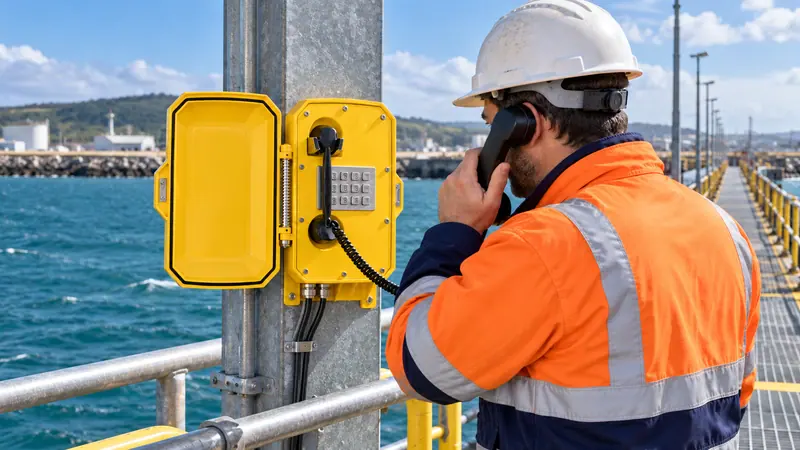
Assess incoming call indication separately. Visual notification may help where machinery masks ringing, subject to sight lines and site requirements. Any external sounder or beacon needs a defined purpose and compatible interface. Include accessories in the scope, power budget and commissioning plan instead of treating them as a final installation detail.
Connect distant areas to staffed destinations
Port communication equipment may be spread across long berths, tank terminals, gates and storage areas. Measure actual cable routes and identify intermediate cabinets. Record which routes cross exposed structures, moving equipment or areas affected by planned construction. These details influence both installation cost and the consequences of a future cable fault.
For IP installations, have the network designer confirm cable distance limits and local power needs. A fiber backbone may be useful across larger sites, with suitable network equipment near endpoints. Include outdoor enclosure conditions, switch temperature limits, surge protection and maintenance access in that design. Each additional cabinet creates another asset to power and maintain.
For existing analog infrastructure, inspect circuit condition and verify compatibility with the proposed exchange or gateway. Test the longest and most exposed routes. Buyers should compare migration costs against usable existing assets, with a documented path for future expansion. The preferred interface depends on the terminal’s infrastructure and support capability.
Give dispatch teams useful call information
Define call destinations by operational responsibility. Marine operations, security and maintenance may each require different call groups. Use clear endpoint names that describe the berth, gate or service area. Ensure the same names appear in the directory and on physical labels so workers and dispatchers share a common reference.
Agree what happens when the primary destination is busy or unattended. A call from a remote service point should have an approved escalation path suited to the hours the area is used. Confirm how temporary closures and changes in staffing are reflected in the configuration. Assign an owner for directory and routing updates.
Coordinate fixed calls and wider messages
Two-way calls support detailed reporting and instruction. Wider announcements can help reach several teams when the operating plan requires it. Define who can initiate those announcements and which areas receive them. Any integration should be demonstrated with the proposed platform, including the behavior of concurrent calls and messages.
Use a simple operating scenario during evaluation: a worker reports a failed access barrier while the usual security position is occupied. Follow the call through to another responsible person. Then check whether the location remains clear if the operator transfers the call. This tests the operational chain behind the equipment specification.
Plan emergency calls around real access routes
Emergency communication should account for the way people move through the terminal. Check that designated call points are accessible from relevant work areas and recognizable to contractors. Review the effect of parked equipment, temporary cargo and restricted zones. A location that is visible during commissioning can become difficult to reach during busy operations.
Coordinate station placement with the terminal’s emergency plan and risk assessment. Confirm who receives an emergency call, how the caller identifies the location and which team initiates further action. Where a terminal handles hazardous cargo, have the responsible engineer determine whether particular installation points require hazardous area equipment and associated approvals.
Test routing and location identification through a controlled exercise. Include realistic staffing and any intended alternate destination. Telephone availability should be reviewed with the site’s other emergency arrangements, including what staff do during a known system outage. Record practical instructions that operators can follow without referring to a technical network drawing.
Evaluate resilience and maintenance costs
Where a separate circuit arrangement is required, assess Joiwo’s Outdoor Dual Circuit Marine Telephone JWAT304. Ask the supplier to document supported interfaces, circuit selection and the required host equipment. Trace shared power supplies and cable routes, then demonstrate the agreed failure scenario. A dual-circuit endpoint needs an appropriate overall design to deliver the intended resilience.
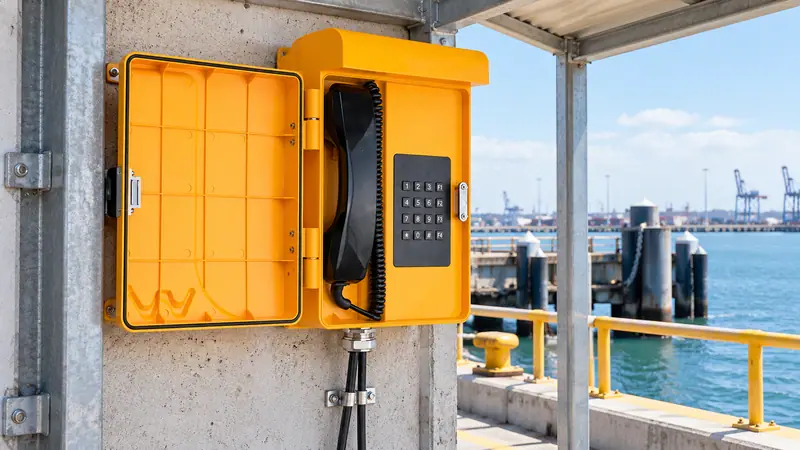
Create inspection routes that fit port access restrictions and working schedules. Maintenance teams should check mounting security, visible corrosion, entries, handset condition and call operation. Request recommended spares and a replacement procedure. A station on a difficult-to-access structure can incur significant service costs even when the replacement component is inexpensive.
Use acceptance tests to close the purchasing process. Call every destination, verify labels, check speech under representative conditions and demonstrate the agreed recovery behavior. Match the installed equipment to approved documentation and record unresolved deviations. Keep configuration backups and final drawings available to the teams responsible for ongoing support.
Purchase a maintainable coastal system
Plan expansion around changes to berth use and cargo patterns. Identify spare network capacity, available cabinet space and the work required to add stations along an extended service route. Ask how future endpoints will receive consistent names and approved call destinations. These details help prevent each extension from becoming a separate, difficult-to-support installation.
For terminals that operate around vessel schedules, agree commissioning windows early. Specify how the installer will coordinate access, protect ongoing operations and restore any temporarily disconnected service. Record who approves the handover for each operating area. A staged acceptance plan allows the terminal to verify useful communication before the contractor moves to the next section.
Compare proposals using the same location schedule, exposure information, operating scenarios and support scope. Ask suppliers to distinguish standard features, optional functions and project-specific work.
Contact Us to discuss your port and marine facility communication requirements and Request a Quote for suitable industrial telephones and supporting equipment.