Correctional facilities and prisons run on communication. From daily inmate counts to full-scale lockdowns, the ability to send and receive clear, controlled information at any moment determines how well a facility operates and how safe it remains.
This article breaks down the following questions:
- What are the demands of prison communication systems
- What devices are available for prison communication
- Which devices belong in which prison spaces
So that teams can evaluate or upgrade their facility infrastructure with a practical, system-level perspective on each of these areas.

Core Demands of Prison Communication Systems
Prison communication systems face demands that no standard commercial product is designed to meet. Durability, continuous availability, and the ability to support emergency response are necessities for any correctional deployment.
High Security and Monitoring Requirements
Every device installed in a correctional facility becomes part of the security envelope. Phones, intercoms, and public address systems must operate on tightly controlled networks that restrict unauthorized access and support continuous monitoring by facility staff.
Call recording, real-time monitoring, and automated flagging are now standard expectations. Many facilities run inmate calling systems that log every call, match voice patterns, and filter conversations against approved contact lists. This level of oversight requires backend infrastructure that can handle high call volumes without gaps.
Network segmentation is equally important. Inmate-facing systems should not share pathways with administrative or emergency systems. Keeping these networks isolated reduces the risk that a compromised device tapping into the facility’s broader infrastructure.
Anti-Vandal and Tamper-Resistant Design
Equipment in cell blocks, common areas, and outdoor spaces faces intentional abuse. Inmates may attempt to damage devices to disable monitoring, create weapons from broken components, or disrupt operations. To prevent such potential threats, anti-vandal and tamper-resistant features are required.
This makes materials selection and physical design as important as any software feature:
- Reinforced 304/316 stainless steel housings with IK10 impact resistance
- Flush-mounted components and recessed buttons
- Tamper and liquid-resistant enclosure
- Fully concealed or protected cabling and connection points
Fast Emergency Response Under Pressure
Response time during critical incidents depends directly on how quickly accurate information moves between inmates, officers, and control rooms.
Emergency help points with single-button activation, priority call routing, and direct lines to control rooms reduce the manual steps between a distress event and a staff response.
Also, public address systems that allow zone-specific broadcasting let command staff direct instructions to affected areas without triggering facility-wide disruption.
Redundant system matters here as well. Backup power, failover routing, and local processing capability ensure that a network disruption does not take down emergency communication simultaneously.
Essential Devices in Correctional Facilities
Four device categories form the functional core of a well-designed prison communication system. Each serves a distinct operational role.
Anti-Vandal Telephone
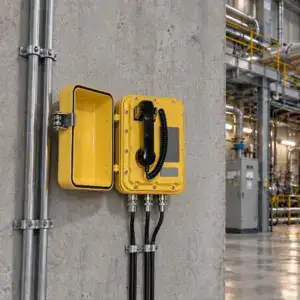
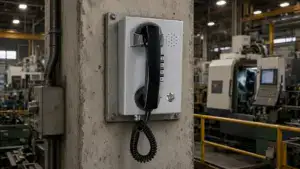
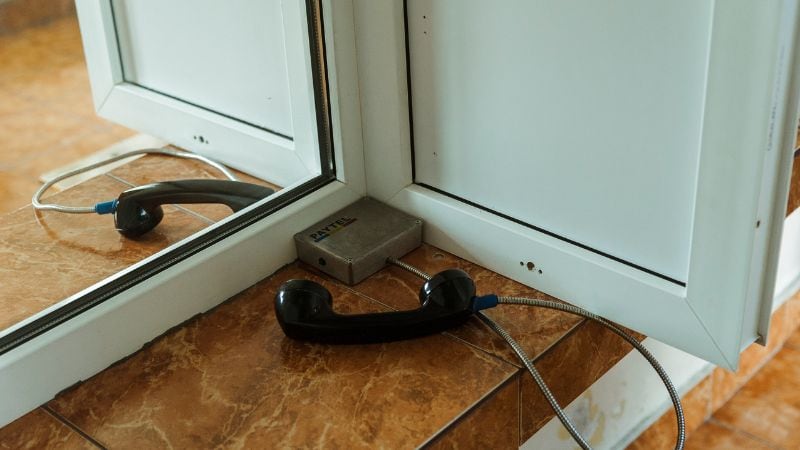
The anti-vandal telephone is one of the most common inmate-facing devices in correctional environments. These telephones are typically installed in cell blocks, housing units, and shared inmate areas where daily use is high and the risk of damage is significant.
They are designed for durability, with features such as heavy-gauge metal construction, tamper-resistant fasteners, recessed components, and minimal removable parts. In many deployments, these phones are connected to controlled calling systems that restrict outbound access and support call supervision.
They are best suited for facilities that need:
- Durable inmate communication devices
- Strong resistance to vandalism and tampering
- Controlled outbound calling in high-use areas
SIP Prison Telephone
SIP prison telephones replace legacy analog infrastructure with IP-based communication. They connect through a managed network and allow administrators to configure call rules, monitor usage, and adjust settings from a centralized platform.
For facilities upgrading older systems, SIP devices offer better visibility and easier management. They are especially useful where centralized administration, integration, and long-term scalability are priorities.
Also, with IP-based communication, it is possible to utilize existing Ethernet networks to significantly reduce cabling costs.
Key advantages of SIP prison telephones include:
- Centralized configuration and control
- Easier integration with broader communication systems
- More flexible system management
- Reduced dependence on legacy analog lines
Emergency Help Point
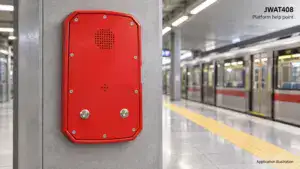
Emergency help points provide a direct channel for immediate assistance. These devices are commonly installed in corridors, stairwells, isolated areas, and other locations where a fast distress signal may be necessary.
They are usually designed for simple activation, often with a single large button. Once triggered, they can route a priority call to the control room and help staff identify the source of the alert quickly.
Emergency help points are especially valuable in areas that need:
- Immediate incident reporting
- Clear location-based response
- Communication access outside standard inmate phone points
Public Address System
A public address system is essential for facility-wide and zone-specific communication. Count instructions, movement control, lockdown orders, and emergency announcements all depend on reliable voice broadcasting.
In correctional facilities, zone control is one of the most important features. Staff may need to address a single housing unit, a specific outdoor area, or the entire facility without creating unnecessary disruption elsewhere.
An effective PA system should support:
- Clear audio coverage in indoor and outdoor spaces
- Zone-based announcements
- Reliable operation during emergencies
- Integration with backup power or redundancy planning
How Different Facility Areas Use Prison Telephones and Intercoms
Each area within a correctional facility presents different communication risks, inmate populations, and staff coverage patterns. Matching the right devices to each zone is a core part of effective infrastructure planning.
Cell Blocks
Cell blocks are the highest-density, highest-risk environment for communication equipment. Anti-vandal telephones in housing units need to handle high daily use while resisting damage from an inmate population that may have both the time and motivation to test their limits.
Access scheduling is a standard practice here:
1. Phones are activated during designated calling windows and disabled outside them, reducing the opportunity for unauthorized use or coordination.
2. Emergency help points positioned near cell doors or in corridor alcoves provide a separate, always-active channel for distress calls that does not rely on the standard phone network.
Control Rooms
The control room functions as the nerve center for all communication systems. Operators monitor incoming calls, respond to emergency help point activations, manage PA broadcasts, and coordinate with staff across the facility in real time.
Integration between systems is the key requirement for control room communication:
1. When a help point activates, the alert should appear immediately on the monitoring console with location data.
2. When a lockdown is ordered, the PA system should be accessible from the same interface without switching between platforms.
Staff in control rooms also need direct intercom lines to key locations including secure housing units, intake areas, and entry/exit checkpoints. These dedicated lines must remain operational even during network issues affecting the broader inmate communication system.
Visitor Areas
Visitor areas require a different communication configuration than the rest of the facility. Contact and non-contact visitation both involve supervised interaction between inmates and approved visitors, and the communication tools in these spaces need to support monitoring without being intrusive or technically unreliable.
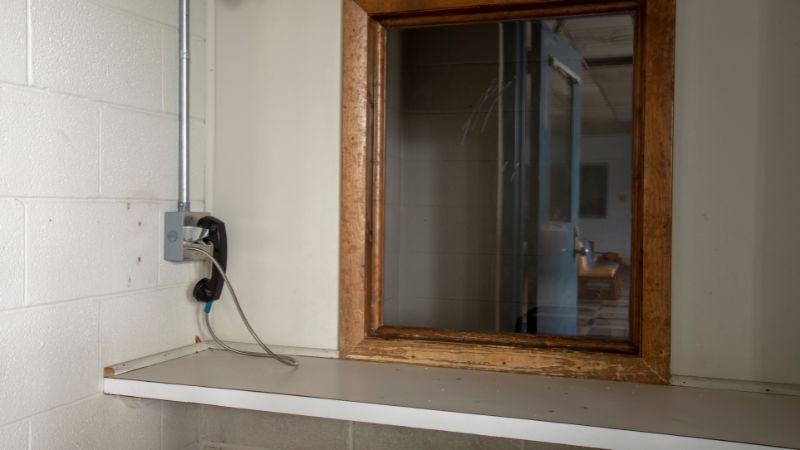
Non-contact visitation booths commonly use telephone handsets or intercom panels that route audio through a monitored system. Video visitation terminals, now common in many facilities, add a visual channel that is also recorded and archived. All visitor-facing devices should be physically durable and clearly marked with usage rules.
Outdoor Exercise Yards
Outdoor yards present the most challenging acoustic environment in any correctional facility. Distance, ambient noise, and weather conditions all reduce the effectiveness of voice communication and public address broadcasts.
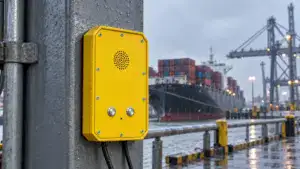
Weatherproof communication devices with proper IP65/IP66/IP67 weather-resistant ratings are essential for PA systems serving outdoor spaces. Emergency help points in yards need to be rated for outdoor installation and positioned where they are visible and accessible without creating blind spots for staff or monitoring cameras.
Anti-vandal telephone installations in outdoor areas face additional durability demands from temperature variation, moisture, and UV exposure. Fully enclosed, weatherproof housing with condensation management is a minimum standard for any outdoor device deployment.
Upgrade Your Correctional Communication Infrastructure with Joiwo
Correctional facilities need communication systems that are not only functional, but also secure, durable, and practical to manage over time. For prisons, jails, and other high-risk environments, equipment selection has a direct impact on safety, maintenance, and operational control.
Joiwo provides prison communication solutions designed for demanding correctional applications, including:
- Anti-vandal inmate telephones
- SIP-based prison communication devices
- Emergency communication equipment
- PA system solutions for critical facility areas
Looking for a reliable prison communication solution? Contact Joiwo to discuss your project requirements, product selection, and system deployment needs.