Industrial facilities in extreme environments rely on communication systems to keep workers safe and operations running. Yet these systems fail at alarming rates — costing companies thousands per hour in downtime. Here’s why it happens and what you can do about it.
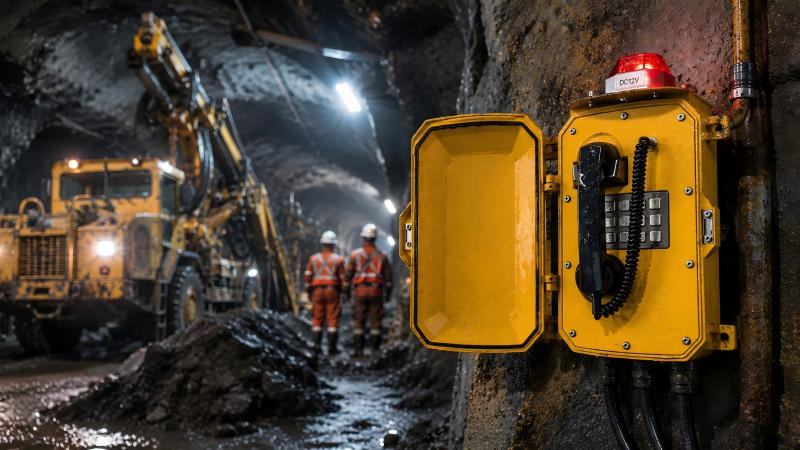
Common Connectivity Challenges in Harsh Industrial Environments
Not all environments are created equal. Communication equipment that works perfectly in an office will fail within weeks — sometimes days — when deployed in industrial settings.
The most destructive environmental factors include:
| Environmental Stressor | What It Does | Typical Failure Timeline |
| Moisture & humidity | Corrodes circuit boards, degrades connections | 6–18 months |
| Dust & particulates | Causes overheating, shorts, keypad jamming | 3–12 months |
| Corrosive atmospheres | Attacks metal contacts and plastic housings | 3–6 months |
| Vibration & shock | Loosens connections, fractures solder joints | 6–24 months |
| Temperature extremes | Cracks seals, fatigues electronic components | 12–36 months |
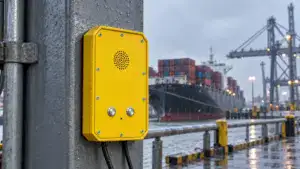
These factors rarely act alone. In oil and gas platforms, for example, you’re dealing with salt spray, vibration from machinery, and explosive atmospheres simultaneously. Mining operations combine dust, humidity, and physical stress from blasting.
The result? Standard commercial equipment degrades rapidly, creating unpredictable failures at the worst possible times.
How Communication Failures Impact Industrial Operations
When your communication network goes down in a hazardous zone, the consequences escalate fast.
| Impact Area | Consequence |
| Safety | Workers cannot report emergencies or receive evacuation alerts |
| Production | Operations halt until communication is restored |
| Compliance | Regulatory violations and potential fines |
| Maintenance | Technicians cannot coordinate repairs or access remote diagnostics |
| Cost | Downtime in mining and oil and gas sectors can exceed $50,000/hour |
Beyond immediate losses, repeated communication failures erode trust in your infrastructure. Teams develop workarounds that bypass safety protocols. Decision-making slows because information flow is unreliable.
Reliable communication isn’t optional in industrial operations — it’s the backbone of everything else.
Why Standard Equipment Fails: The Technology Gap
Most communication failures in challenging environments trace back to one root cause: deploying equipment that wasn’t designed for the conditions.
Material and Build Quality
Consumer-grade phones and network devices use plastic housings, rubber seals rated for moderate conditions, and connectors designed for indoor use. In industrial conditions, these materials break down:
- Plastic becomes brittle in extreme temperatures (-40°C to +70°C)
- Standard rubber seals degrade when exposed to chemicals or UV
- Nickel-plated connectors corrode in salt-air or corrosive environments
Ruggedized industrial telephones use stainless steel or die-cast aluminum housings, marine-grade seals, and gold-plated or sealed connectors that maintain signal integrity for years.
Network Architecture Weaknesses
Many industrial sites still rely on legacy systems with single points of failure. A single damaged cable or failed switch can take down communication across an entire facility.
Modern connectivity solutions address this through:
- Ring topology with automatic failover
- Redundancy in both cabling and switching equipment
- Edge computing nodes that maintain local communication during backhaul outages
- Support for multiple protocols (SIP, analog, ethernet) on a single platform
Key Design Features of a Reliable Weatherproof Industrial Telephone
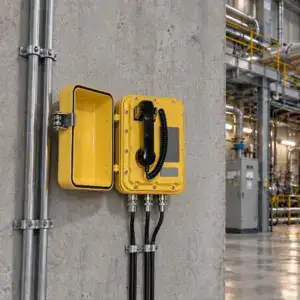
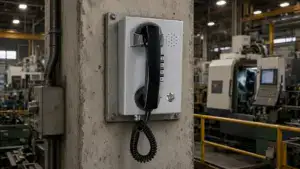
JOIWO’s purpose-built industrial IP phones use multiple layers of protection working together. Here’s what separates industrial-grade from consumer-grade:
IP Ratings and Certification
- IP66/IP67 ratings = completely dust-tight + protected against powerful water jets or temporary immersion
- Prevents the moisture and dust ingress responsible for most premature failures
- Critical for offshore platforms, tunnels, and washdown areas
| Environment | Minimum IP Rating | Additional Certification |
| Indoor factory (dust) | IP65 | — |
| Outdoor / coastal | IP66-IP67 | Salt spray resistance |
| Washdown areas | IP67-IP68 | Food-grade (if applicable) |
| Underground mining | IP66 | IECEx / ATEX Zone 1 |
| Oil and gas platforms | IP66-IP67 | ATEX / IECEx certification |
| Tunnel systems | IP65-IP66 | Fire resistance rating |
Never deploy equipment without verifying its certification matches your environment’s hazard classification.
Corrosion-Resistant Materials
The right material selection determines whether your phone lasts months or decades:
- Stainless steel housings — salt spray and chemical resistance
- Marine-grade aluminum alloy — lightweight yet extremely durable
- UV-stabilized engineering plastics — resists sun degradation in outdoor installs
JOIWO uses in-house die-casting and laser-cutting equipment to produce housings with precise tolerances and consistent wall thickness across every unit.
Vibration and Impact Resistance
- Reinforced internal mounting systems
- Potted electronics that absorb shock
- Armored cable entries and robust hook switches
- Shock-absorbing handset cradles
These features eliminate the weak points where vibration-induced failures typically start.
Wide Operating Temperature Range
Components rated from -40°C to +70°C prevent thermal cycling failures. Specialized sealing compounds maintain elasticity across this full range—keeping enclosure integrity intact year after year.
EMI/EMC Shielding
Heavy machinery, variable frequency drives, and radio transmitters create electromagnetic interference that disrupts signals. Industrial telephones counter this with:
- Shielded cabling
- Filtered power inputs
- Grounded metallic enclosures
Result: clear audio quality regardless of the electromagnetic environment.
Building a Resilient Communication Network for Challenging Environments
Equipment selection is only half the battle. Your network architecture determines whether the system delivers seamless, uninterrupted connectivity over time.
Design Principles
Redundancy at every level. Deploy backup communication paths so a single failure doesn’t isolate any area. Ring networks, dual-homed connections, and wireless backup links (Wi-Fi, LTE) all contribute to uptime.
Distributed intelligence. Don’t concentrate all switching in one location. Place processing at the edge so local communication continues even during network disruptions. This is particularly critical in geographically spread operations like pipeline corridors or tunnel systems.
Scalable architecture. Your deployment should accommodate growth. Choose a platform that lets you add connected devices — sensor arrays, additional phones, IIoT endpoints — without redesigning the backbone.
Environmental monitoring. Integrate real-time monitoring of equipment health. Modern industrial communication systems can report temperature, connectivity status, and signal strength back to a central management platform — enabling predictive maintenance before failures occur.
Maintenance Strategy
Even ruggedized equipment requires planned maintenance to achieve maximum longevity:
- Schedule quarterly visual inspections of housings and cable entries
- Test emergency communication endpoints monthly
- Update firmware on managed devices per manufacturer recommendations
- Monitor network performance data for early warning of degradation
- Maintain spare inventory for critical components to reduce maintenance response time
This proactive approach delivers measurable cost savings compared to reactive break-fix maintenance.
Where Harsh Environment Communication Matters Most
Industrial communication systems engineered for extreme environments serve across multiple sectors:
- Oil and gas — offshore platforms, refineries, pipeline stations
- Mining — underground tunnels, open-pit operations, processing plants
- Transportation — highway tunnels, railway corridors, metro systems
- Marine — vessels, ports, shipyards
- Manufacturing — steel mills, chemical plants, factory floors
- Agriculture — remote processing facilities, grain silos
- Power generation — nuclear plants, substations, wind farms
Each sector presents unique combinations of environmental challenges. The common thread? All require communication equipment purpose-built for industrial environments — not adapted from commercial products.
Successful deployment in these sectors demands equipment with proven longevity, appropriate certification, and robust solutions for data transmission in environments where standard technology simply cannot survive.
Partner with JOIWO for Reliable Industrial Communication
JOIWO is a specialized manufacturer of robust industrial communication systems for high-risk environments worldwide. With in-house R&D, certified manufacturing facilities, and proven deployments across oil & gas, mining, maritime, and nuclear industries, JOIWO delivers the harsh environment communication solutions your operations demand.
If you’re looking for a reliable industrial telephone manufacturer, contact us to discuss your project requirements or request a quote.
FAQs
What IP rating do I need for outdoor industrial telephones?
For most outdoor industrial environments, IP66 is the minimum — protecting against powerful water jets and complete dust ingress. If your equipment faces submersion risk or high-pressure washdown, look for IP67 or IP68. Always verify the rating covers your specific environmental threats.
How do extreme temperatures affect communication equipment?
Extreme temperatures cause seal degradation, LCD failure, battery malfunction, and solder joint cracking. Industrial-grade equipment is designed with wide operating ranges (typically -40°C to +70°C) using materials that maintain stable connections across thermal cycles.
Can I integrate new industrial IP phones with my existing PBX system?
Yes. Most modern industrial IP phones support SIP protocol, which enables integration with both legacy PBX systems and modern VoIP platforms. This allows phased deployment — upgrading endpoints without replacing your entire communication infrastructure simultaneously.
How often should industrial communication equipment be maintained?
For equipment deployed in harsh conditions, quarterly inspections are recommended as a minimum. However, systems with remote monitoring capabilities can shift to condition-based maintenance — intervening only when diagnostics indicate degradation, which reduces unnecessary on-site visits.
What’s the typical lifespan of a weatherproof industrial telephone?
Quality ruggedized industrial telephones deployed in appropriate conditions typically last 15-25 years. This longevity depends on correct installation, environmental match (don’t under-spec), and adherence to maintenance schedules. The extended lifespan is what makes the higher upfront investment worthwhile.