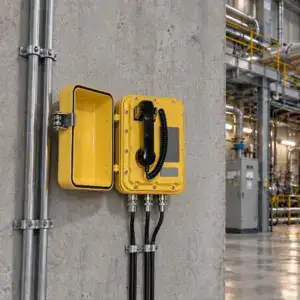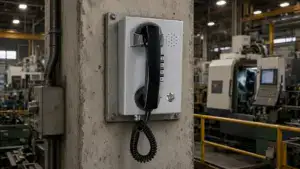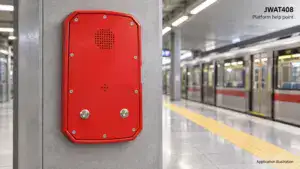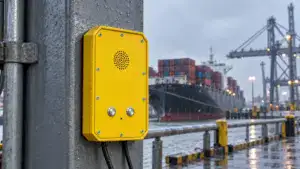
If you’re still running a traditional analog phone system at your facility, 2026 might be the year that changes. Across oil refineries, tunnels, power plants, and ports, industrial operators are accelerating their shift to VoIP-based communication — and for good reason.
VoIP vs. Analog Phone System: Understanding the Core Difference
Before comparing the two, it helps to understand what sets them apart at a fundamental level.
Analog phone systems — also known as plain old telephone service (POTS) — transmit voice over copper wire using continuous electrical signals. They’ve been around for over a century and are what most people think of as a traditional phone.
VoIP (Voice over Internet Protocol), on the other hand, converts voice into digital data packets and transmits voice data over an IP network or the internet. An industrial IP telephone or SIP industrial phone connects to your existing network infrastructure rather than relying on dedicated copper wiring or analog lines.
Here’s a quick side-by-side:
| Feature | Analog Phone System | Industrial IP Telephone (VoIP) |
| Signal transmission | Copper wire (electrical) | IP network (data packets) |
| Scalability | Limited, costly wiring | Easily scalable over existing LAN |
| Advanced features | Basic calling only | Auto attendant, video, dispatch integration |
| Maintenance | Onsite technician required | Remote maintenance and updates possible |
| Infrastructure dependency | Dedicated phone line per device | Shared IP/broadband network |
| Long-term viability | Declining (ISDN shutdown by ~2030) | Growing — global VoIP market expanding |
The difference between analog and IP telephony isn’t just technical — it’s strategic. Choosing your phone system today means choosing how your facility communicates for the next decade.
Related read: Differences and Advantages of Analog and Digital Telephone Systems
Why Industrial Facilities Are Moving Away from Analog Telephony
Traditional analog systems — also known as POTS (Plain Old Telephone Service) — carry voice signals over copper wire. They’re simple, and they work. But in demanding industrial environments, “simple” often means “limited.”
The core pain points facilities report most often:
- High maintenance costs — aging copper infrastructure requires frequent repairs
- No remote management — faults must be diagnosed on-site
- Limited scalability — adding new stations means running new physical wiring
- No integration — analog systems sit in isolation from modern dispatch, alarm, and SCADA platforms
- Declining vendor support — fewer manufacturers service legacy analog hardware
For facilities in oil and gas, mining, tunnels, or power generation, these limitations aren’t just inconvenient — they’re operational risks.
SIP Industrial Phones: Seamless Integration with Modern Dispatch Systems
One of the biggest advantages of a SIP industrial phone or industrial IP telephone over an analog phone is how cleanly it integrates into existing digital infrastructure.
Integration with VoIP and Dispatch Systems
Modern industrial facilities typically run multiple communication layers — emergency dispatch, PA systems, intercoms, and control room consoles. An analog phone system operates in isolation; it can’t easily interface with these digital systems without costly gateways and workarounds.
A VoIP industrial communication setup is built around standard SIP protocols, which means:
- Direct integration with IP PBX systems and VoIP servers
- Compatibility with dispatch consoles, operator workstations, and softphone clients
- SIP trunking to replace traditional phone lines, reducing infrastructure overhead
- Auto attendant and call routing configured in software, not hardware
- Integration with public address (PA) and emergency broadcast systems
Facilities like offshore oil rigs, wind power plants, and underground tunnels increasingly need this kind of unified communication — where a single alarm event can simultaneously trigger an IP telephone alert, a PA broadcast, and a control room notification.
JOIWO’s IP PBX telephone systems — including VoIP servers, gateways, and operator consoles — are built to work alongside weatherproof and explosion-proof endpoints in a single, cohesive industrial telephone system. This is especially relevant for complex sites like chemical plants, offshore platforms, or underground utility corridors, where disparate systems need to communicate reliably. Explore how JOIWO approaches integrated industrial communication solutions here.
Scalability and Maintenance: Where VoIP Industrial Communication Wins
If you’re managing a large or expanding facility, scalability is where IP systems deliver the clearest return on investment.
Adding New Endpoints Is Simple
With analog, every new telephone station requires pulling new cable runs — costly and time-consuming. With an IP-based industrial telephone system, you simply plug a new endpoint into the existing network switch. Configuration is handled remotely through the IP PBX.
Maintenance Becomes Predictive, Not Reactive
IP phones can be remotely monitored for connectivity, firmware status, and fault conditions. Instead of waiting for a phone to fail and then dispatching a technician, your team gets alerts before issues escalate.
Reduced Total Cost of Ownership
While the upfront investment in an IP system can be higher than replacing like-for-like analog hardware, the long-term savings are significant:
- Less wiring infrastructure to maintain
- Remote diagnostics reduce field service calls
- Centralized software management reduces IT overhead
- Longer hardware lifecycle with firmware-updateable devices
Reliability in Harsh Environments: What the Data Shows
A common concern when evaluating VoIP vs. analog phone systems is reliability. The traditional argument runs: “Analog phones work even when the power goes out.” And historically, that was a fair point.
But the reality in 2026 is more nuanced.
Modern VoIP industrial phones are engineered specifically for harsh environments. They meet IP66/IP67 ingress protection ratings, withstand extreme temperatures, and are built with ruggedized housings — stainless steel, die-cast aluminum — that traditional phone handsets simply can’t match. Many are also ATEX/IECEx certified for use in explosive atmospheres.
Regarding network reliability: enterprise-grade IP networks and broadband connectivity now routinely deliver 99.99% uptime. With PoE (Power over Ethernet) and UPS backup systems, an IP telephone system can be just as resilient as — or more resilient than — an aging analog system running on deteriorating copper wire infrastructure.
The reliability concern that once favored analog telephony has largely been answered by industrial-grade VoIP design and redundant network architecture. For a deeper look at how industrial telephones are certified for hazardous environments, see our guide on ATEX certification for industrial communication equipment.
The 2026 Industrial Communication Landscape at a Glance
The voip market continues to grow rapidly, and industrial applications are a key driver. Here’s what modern industrial telephone system buyers are prioritizing:
- VoIP industrial communication that integrates with SCADA, dispatch, and PA systems
- SIP industrial phones with rugged, weatherproof, or explosion-proof enclosures
- Hosted VoIP and on-premise IP PBX options depending on connectivity availability
- Phased migration strategies — using VoIP gateways to bridge existing analog and digital infrastructure during transition
- Business communication continuity: ensuring zero downtime during switchover
Projects ranging from nuclear power plants to metro rail systems are now specifying VoIP-based telephone systems as standard. The question isn’t whether to make the transition — it’s how to plan it well.
Partner with JOIWO for Reliable Industrial Communication
JOIWO is a specialized manufacturer of robust industrial communication systems for high-risk environments worldwide. With in-house R&D, certified manufacturing facilities, and proven deployments across oil & gas, mining, maritime, and nuclear industries, JOIWO delivers the harsh environment communication solutions your operations demand.
If you’re looking for a reliable industrial telephone manufacturer, contact us to discuss your project requirements or request a quote.